
On the southern edge of Prague, perched above the Vltava on a rocky promontory called Barrandov, sits one of the largest and oldest film studios in Europe. Barrandov Studios has been in continuous operation since 1933, survived Nazi occupation, Communist nationalization, and the shift to Hollywood co-productions, and today counts Amadeus, Mission: Impossible, Les Misérables, and The Brothers Grimm among the films shot on its stages. Most visitors to Prague never make it out here. That’s their loss.
A Brief History
The studios were founded by Miloš Havel — uncle of future Czech president Václav Havel — who envisioned Barrandov as a Central European answer to Hollywood. The complex he built was ambitious: multiple large soundstages, a terrace restaurant, and a swimming club carved into the cliffs above the river, all in a clean modernist style that still looks striking today. The Havel family lost the studios after the Communist coup in 1948, but the infrastructure they built proved resilient. Soviet-era Czechoslovakia used Barrandov to produce an extraordinary volume of domestic films — the Czech New Wave of the 1960s, which gave the world directors like Miloš Forman and Jiří Menzel, was largely shot here.
After 1989, the studios were privatized and quickly attracted Western productions drawn by competitive costs, skilled crews, and the visual variety Prague offers as a stand-in for other European cities. The backlot can be dressed as Paris, Vienna, or a generic 19th-century streetscape with relatively little effort. For a certain era of Hollywood, Barrandov was simply the most practical place to shoot in Europe.
Visiting the Studios
Barrandov is an active working studio, not a theme park, which means access is limited — but not impossible. Guided tours run periodically and take in the soundstages, the costume and prop warehouses, and the backlot street sets. The prop collection alone is worth the trip: decades of accumulated furniture, signage, vehicles, and costumes from productions spanning nearly a century. It’s the kind of place where you turn a corner and find a row of period-correct telephone booths next to a rack of 18th-century military uniforms.
Check the studio’s website for current tour schedules, as they vary by season and depend on whether stages are in active production. Booking ahead is recommended. The studios are reachable by tram from the city center — tram 12 runs out to the Filmové ateliéry Barrandov stop, a ride of about 30 minutes from Malá Strana.
The Barrandov Terraces
Just below the studios, the Barrandov Terraces — the restaurant and terrace complex built by Miloš Havel in the 1920s — have been restored and reopened. The views over the river valley are excellent, and the building itself is a good example of Czech functionalist architecture at its most confident. It’s a quieter, more local side of Prague than anything you’ll find in the old town, and a natural stop to pair with a studio visit.
Worth the Trip?
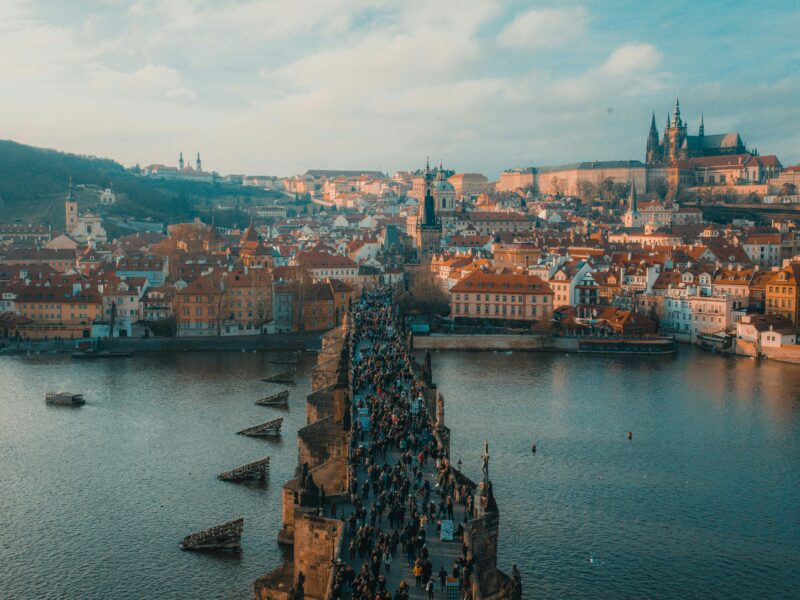
If you have more than two days in Prague and any interest in film history, architecture, or the less-visited corners of the city — yes, unequivocally. Barrandov sits outside the usual tourist circuit, which means the experience feels genuinely off the beaten path even though it’s thirty minutes from the old town by tram. It’s a reminder that Prague’s cultural history runs much deeper than the medieval skyline suggests.